 HBWEB GAME PORTAL
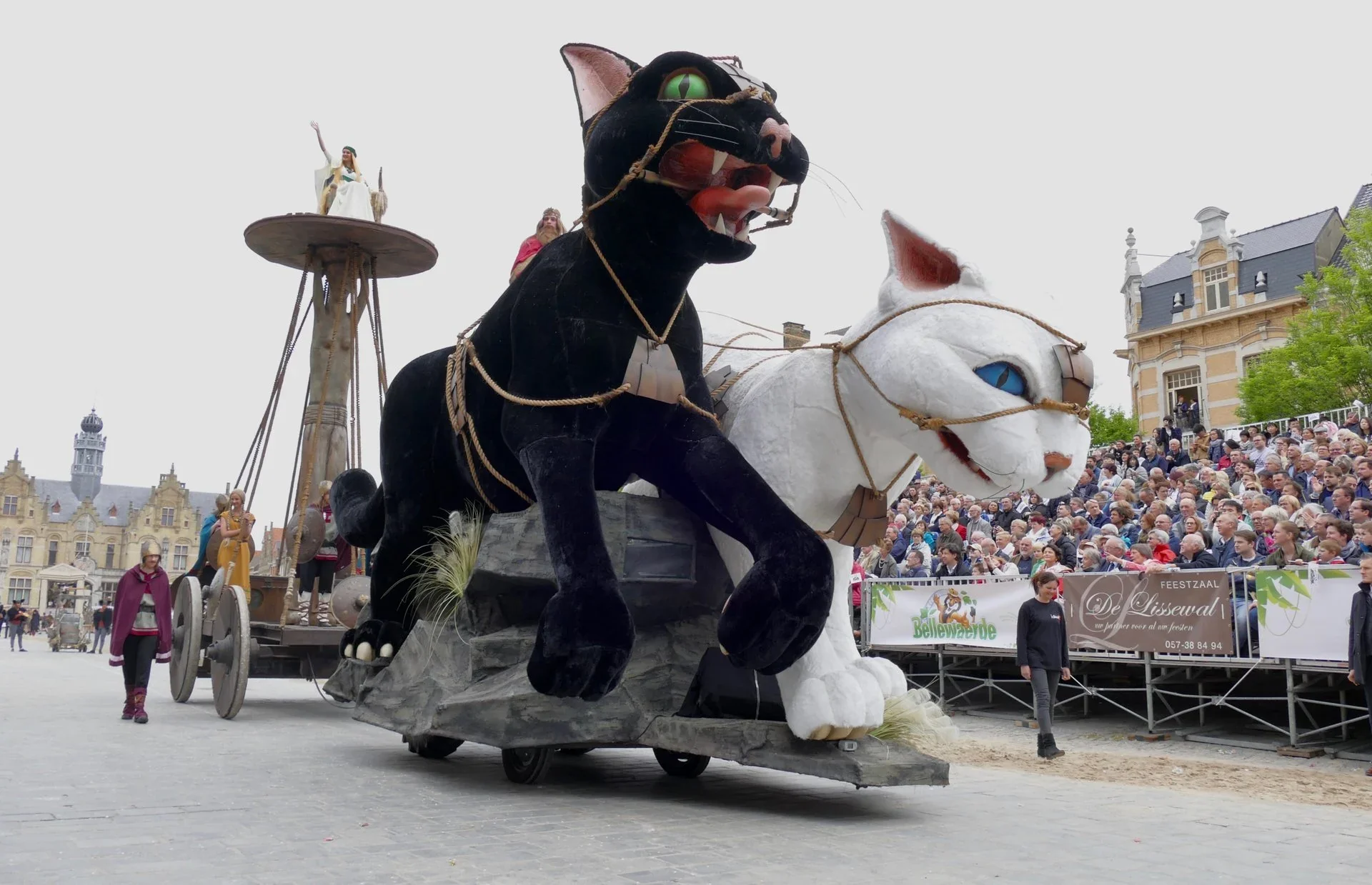
If you think your cat has a strange life, wait until you hear what humans do for cats around the world.
In some places, cats have their own festivals. In others, they appear in religious ceremonies, lucky charms, and centuries-old legends. There are even towns where people dress up, parade through the streets, and throw toy cats from a tower.
Yes, you read that correctly. Toy cats. From a tower.
Apparently, the internet didn't invent humanity's obsession with cats. We were perfectly capable of being ridiculous about them long before anyone had Wi-Fi.
From Japan's lucky feline figurines to Belgium's legendary Cat Parade, here are some of the weirdest, most fascinating cat traditions from around the world. And if your cat already believes the entire household exists to serve it, some of these customs might explain why.
1. Belgium: The Town That Throws Cats From a Tower
Imagine visiting a beautiful European town and discovering that one of its biggest celebrations involves a parade of cats, a town jester, and plush felines raining down from a tower.
Welcome to Ypres, Belgium.
<PRIVATE_PERSON>Ypres is home to the famous Kattenstoet, or Cat Parade, a festival dedicated to cats and their place in local history and folklore. The first large-scale parade took place in 1955, although a smaller cat procession had already been held in 1938.
During the celebration, participants dress in elaborate costumes, giant cat figures move through the streets, and the parade explores everything from cat legends to the animal's role in history.
But the strangest part comes near the end: a town jester throws plush cats from the belfry of the Cloth Hall.
Before you imagine a medieval cat-throwing competition, relax. These are stuffed toys, not real cats. Spectators gather below to catch them, turning the event into a delightfully chaotic feline free-for-all.
The tradition has a darker historical background. In medieval Ypres, cats were associated with the cloth trade and were once thrown from the belfry in a practice connected to old beliefs and local customs. Today's festival transforms that uncomfortable history into a playful celebration of the town's identity.
The modern parade also helped bring the community together after the devastation of the world wars.
The cat-owner interpretation: Imagine your local council organizing an entire parade because people couldn't stop thinking about cats. Actually, that sounds less strange than some of the things we already do for our pets.
Source: Official Kattenstoet website.
2. Japan: A Special Day for Cats
Japan has a well-earned reputation for taking its love of cats to impressive levels. Cat cafés, cat-themed souvenirs, feline mascots, and entire islands famous for their cat populations are only part of the picture.
Then there's Cat Day, celebrated on February 22.
Why that date? In Japanese, the number two is pronounced ni. Say 2/22 aloud in a playful way, and it can sound like nyan nyan nyan — a Japanese imitation of a cat's meow.
In other words, the date practically meows at you.
The celebration gives cat lovers an excuse to share photographs, buy cat-themed treats, visit feline attractions, and shower their pets with extra attention.
Of course, anyone who lives with a cat knows that February 22 is hardly the only day deserving of a celebration. There's also the day your cat finally uses the expensive bed you bought, the day it doesn't knock over your drink, and the historic occasion when it allows you to work for ten uninterrupted minutes.
Those events deserve national holidays, too.
Japan is also famous for maneki-neko, the beckoning cat figurine often displayed in shops, restaurants, and homes. The familiar figure usually has one paw raised and is associated with inviting good fortune, customers, or prosperity.
Different colors and designs carry different associations, although meanings can vary by tradition and seller.
The figurine isn't simply a cute decoration. It's a symbol of good luck that has traveled far beyond Japan.
The cat-owner interpretation: Humans invented a whole day to celebrate cats, and cats still act as though the celebration is running behind schedule.
3. Japan Again: The Lucky Cat That Never Gets Tired of Waving
Have you ever noticed a little cat figurine sitting near a shop's entrance, raising one paw as if it's trying to get your attention?
That's probably a maneki-neko, often translated as the beckoning cat.
These figurines are among Japan's best-known symbols of good fortune. They're commonly displayed in businesses and homes, where they are believed to invite prosperity, customers, or good luck.
The origins of maneki-neko are surrounded by stories and legends. One popular tale involves a cat beckoning a traveler toward safety or shelter, while other versions connect the figure to temples and local folklore.
There isn't just one universal design, either. Some cats hold coins, others have different colors, and many are decorated with elaborate collars and bells.
The raised paw is often interpreted as inviting something good into your life. Depending on the design, that might mean money, customers, or general good fortune.
Think of it as a tiny feline business consultant.
The funniest part is that the figurine never clocks out. It sits there waving all day, every day, without demanding a lunch break or knocking the office printer off a desk.
Meanwhile, your real cat sleeps through half the afternoon and still expects a bonus.
The cat-owner interpretation: If your cat had a job, it would probably demand payment in premium treats, reject every uniform, and spend the entire shift staring at a wall.
For more about the history of the beckoning cat, see Japan's official tourism website.
4. Italy: Cats and Other Pets Receive Blessings
In parts of Italy, animals receive special attention during celebrations honoring Saint Anthony the Abbot, a figure traditionally associated with the protection of domestic animals and livestock.
The feast day falls on January 17, and some communities hold ceremonies where animals are brought to churches or churchyards for a blessing.
Historically, these ceremonies were especially important to farming communities. Healthy livestock meant food, income, and survival, so asking for protection for animals was a meaningful part of rural life.
Today, depending on the location, the animals attending these ceremonies can include horses, farm animals, dogs, and cats.
Picture the scene: people arriving with their beloved pets, families gathering outside a church, and a cat sitting in its carrier looking deeply suspicious of the entire arrangement.
Is the cat aware that it's attending a religious ceremony? Probably not.
Does it care that everyone has made a special effort on its behalf? That depends on whether someone brought snacks.
These blessings are not exclusively for cats, but they reveal something lovely about the relationship between people and animals: caring for an animal has long been about more than simply keeping it fed.
The cat-owner interpretation: Your cat may refuse to acknowledge your existence when you call its name, but you would still happily take it to a special ceremony to wish it a long, healthy life.
Honestly, that's love.
Source: Italian National Tourism Board — The Church of St Anthony Abbot in Maenza.
5. Ancient Egypt: Cats Were More Than Just Pets
Long before cats became internet celebrities, they held an important place in ancient Egyptian society.
Cats were valued for their ability to control rodents and protect food supplies. Over time, they also became associated with religious beliefs, protection, and domestic life.
One of the best-known feline deities was Bastet, a goddess associated with protection, fertility, and the home. She was often represented as a lioness in earlier imagery and later as a woman with a cat's head.
Cats also appeared in Egyptian art and were sometimes mummified, reflecting the religious and cultural significance they could hold.
However, it's worth avoiding the popular oversimplification that every ancient Egyptian cat was treated exactly like royalty. Attitudes and practices varied across periods and communities, and the religious meaning of cats was more complex than a simple national obsession with pets.
Still, the connection between cats and ancient Egypt remains one of the most fascinating chapters in feline history.
Imagine being a cat in ancient Egypt. You could wander around the house, supervise the humans, and perhaps even inspire religious artwork.
Fast-forward thousands of years, and your modern descendant is doing essentially the same thing — except now the humans are taking 300 photographs of it sleeping on a laundry basket.
Some traditions change. Cat behavior apparently doesn't.
The cat-owner interpretation: Your cat may not have a temple, but it probably has a favorite chair that you're no longer allowed to use. For practical purposes, the difference is small.
6. Turkey: Street Cats Become Part of Everyday Life
In Istanbul, cats are more than a familiar sight. They have become part of the city's public identity.
You'll find them resting outside shops, wandering through courtyards, sitting near cafés, and appearing in photographs taken by visitors.
Many residents and shopkeepers look after neighborhood cats by providing food, water, or shelter. Some cats are so familiar to the people around them that they seem less like stray animals and more like unofficial neighborhood residents.
This isn't one single festival or formal ceremony. It's a collection of everyday habits and community attitudes that have developed over time.
The result is a city where encountering a cat during an ordinary walk can feel almost inevitable.
And the cats? They seem perfectly comfortable with their status.
One might nap beside a shop entrance as if it owns the property. Another may settle into a café chair with the confidence of someone who has personally approved the building's design.
Tourists stop to take pictures. Residents carry on with their day. The cat continues its nap.
There is also a famous documentary, Kedi (2016), which follows street cats in Istanbul and the people whose lives they touch.
The film captures something that statistics alone can't explain: the relationship between a city and the animals who share its streets.
The cat-owner interpretation: In many places, people ask who owns the cat. In Istanbul, the more useful question might be: which humans are currently on duty?
7. Belgium's Cat Parade Has a Surprisingly Serious Side
Let's return to Ypres, because its cat tradition deserves another look.
It's easy to focus on the costumes, the giant cat figures, and the plush toys falling from the tower. But the Cat Parade isn't simply an excuse for a town to dress up as felines.
Its history is tied to the city's identity and the way communities preserve, reinterpret, and sometimes reclaim their past.
The modern parade grew during the 1950s, when Ypres was rebuilding after the destruction of the world wars. A major public celebration gave residents a shared project and helped draw attention back to the city.
The parade now brings together folklore, humor, costumes, music, and local pride. Its themes explore cats in language, history, legends, and popular culture.
That means a visitor might see a giant cat one moment and a theatrical scene inspired by an old legend the next.
It's also a reminder that traditions don't always remain frozen in their original form. A custom can change meaning as people decide how they want to remember it.
And yes, the plush cats are still a memorable part of the spectacle.
The cat-owner interpretation: Some people preserve their town's heritage with museums and monuments. Ypres also has a giant celebration involving cats. There's room for both — although your cat would probably prefer the parade to include a buffet.
So, Why Are Humans So Obsessed With Cat Traditions?
From Japan's lucky cat figurines to Italy's animal blessings and Belgium's extraordinary Cat Parade, feline traditions reveal different ways people have connected cats with their communities, beliefs, and everyday lives.
Some traditions celebrate good fortune. Others preserve local history or express religious devotion. Still others simply give people an excuse to come together and have fun.
Cats have inspired these customs partly because they occupy such an unusual place in human life. They can be working animals, beloved companions, cultural symbols, and sources of endless entertainment.
They also happen to be very good at making themselves memorable.
A dog might greet you enthusiastically when you come home. A cat might look at you as though you've returned late from an important meeting — one that it never agreed to schedule.
And yet, people keep building traditions around them.
Maybe that's the real magic of cats. They don't need to do anything particularly extraordinary to inspire affection. Sometimes, all they need to do is exist, look mysterious, and sit somewhere they absolutely shouldn't.