 HBWEB GAME PORTAL
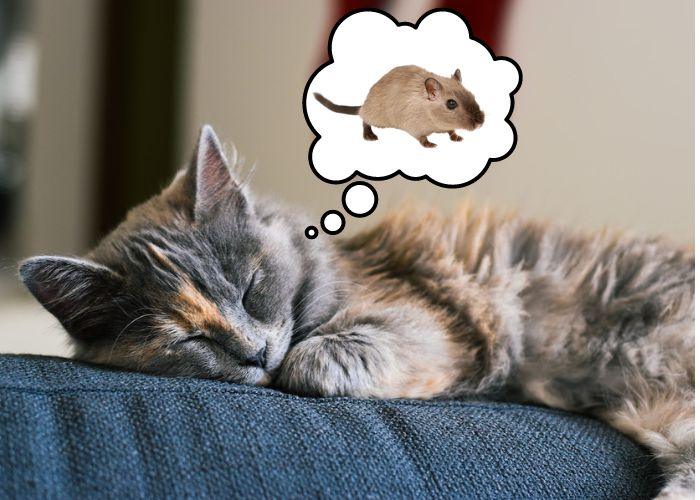
It's 2 a.m. Your cat is curled up on the bed, sleeping peacefully. Everything is quiet. The house is calm.
Then, suddenly, one tiny paw starts twitching.
Its whiskers tremble. Its ears flick. Its tail gives a little wiggle, and a strange little sound escapes its mouth.
Is your cat dreaming about chasing a mouse? Battling a terrifying vacuum cleaner? Finally catching the red dot that has been humiliating it for years?
Or is it dreaming about you?
Hopefully, you're the hero of the story. Although, considering how your cat looks at you when breakfast is late, you might actually be the villain.
Scientists cannot ask cats to describe their dreams over breakfast, unfortunately. But research into animal sleep gives us some fascinating clues about what might be happening inside those furry little heads.
And the possibilities are absolutely delightful.
1. First Things First: Do Cats Actually Dream?
The short answer? They very likely do.
Cats experience different stages of sleep, including rapid eye movement sleep, better known as REM sleep. In humans, REM sleep is strongly associated with vivid dreaming. Cats also show REM sleep, during which their brains are active while most of their body muscles remain relaxed.
This doesn't let us watch a cat's dream like a movie. However, it gives scientists good reasons to think that cats probably experience some form of dreaming.
Researchers have studied feline sleep for decades. In early experiments, French neuroscientist Michel Jouvet investigated the brain mechanisms involved in REM sleep in cats. His work helped scientists understand how the brain normally limits movement during this sleep stage.
The fascinating part is that sleep is not simply a period when the brain switches off. The sleeping brain remains active, and sleep plays important roles in memory and learning.
So when your cat is snoozing on the sofa for the sixth time today, it might be doing something more complicated than looking adorable.
It might be processing information from its day.
Or it might simply be enjoying the world's most comfortable nap.
We can't know for certain. Cats remain frustratingly unwilling to complete scientific questionnaires.
2. Is Your Cat Dreaming About Hunting You? Probably Not. Hopefully.
Imagine your cat's dream world.
A tiny mouse appears.
Your cat crouches low, wiggles its backside, and prepares for the greatest hunt in feline history.
It launches forward!
Success!
The mouse escapes.
Your cat wakes up, looks at your ankle, and decides that a moving foot will have to do.
Okay, we made up the movie. But hunting is a reasonable possibility when we think about what cats experience during their waking hours.
Domestic cats retain strong hunting instincts. Even cats that have never caught a real mouse may stalk toys, pounce on moving objects, and chase imaginary prey across the living room.
Because dreams in humans are often connected with memories and everyday experiences, researchers think animal dreams may also involve familiar activities. For cats, these could plausibly include stalking, chasing, playing, or exploring.
However, there is an important catch: scientists cannot confirm that a twitching cat is dreaming about a particular hunt.
A moving paw doesn't come with subtitles.
So we can imagine your cat chasing a mouse in its sleep, but we cannot honestly claim to know that's what's happening.
Still, if your cat wakes up looking deeply offended, it's entirely possible that its dream mouse got away.
And if the dream mouse was made of chicken, the disappointment may be even greater.
3. The Mystery of the Twitching Paws
This is the part every cat owner has probably witnessed.
Your cat is fast asleep. Suddenly, its paws begin making little running movements. Its whiskers twitch. Its ears flick, and its tail moves as though it has received an urgent message from headquarters.
What is going on?
Small movements can occur during sleep, including REM sleep. These movements are consistent with activity in the nervous system while the cat sleeps.
They may look like running, jumping, or chasing something invisible, which is why people often assume their cats are dreaming about adventures.
And honestly, the resemblance is impressive.
One moment, your cat looks like a peaceful ball of fluff. The next, it appears to be participating in an imaginary Olympic final.
But movement alone cannot tell us what a cat is dreaming about—or even prove that every little twitch is part of a dream.
Most mild, brief movements during sleep are normal. If movements seem unusually intense, occur while the cat is awake, or come with other worrying signs, it's sensible to seek veterinary advice rather than automatically assuming the cat is dreaming.
Otherwise, you can simply enjoy the tiny performance.
Just resist the temptation to provide sports commentary.
"AND THE CAT IS OFF! A STUNNING START! OH, IT'S SCRATCHING ITS OWN EAR!"
Your cat has not consented to being an athlete.
4. Does Your Cat Dream About You?
Now we arrive at the question every affectionate cat parent secretly wants answered.
When your cat sleeps beside you, does it dream about your face? Your voice? The hand that delivers dinner every evening?
We can't know for sure.
Scientists have not established exactly what cats experience in their dreams, so there is no reliable way to say that your cat dreams about a particular person.
However, cats are capable of learning about their environment and forming familiar relationships. Your daily routines, voice, movements, and interactions are all part of your cat's waking experience.
It is therefore plausible that familiar people or experiences could feature in a cat's dreams.
Notice the word plausible. It is not the same as proven.
Still, it's a lovely thought.
Perhaps your cat dreams about sitting beside you on the sofa, receiving a gentle scratch behind the ears, or waiting for dinner while you somehow take an entire century to open a tin.
Or perhaps you appear in the dream only as a giant hand holding a treat.
Honestly, that might be the highest honour a cat can give you.
You don't need to know exactly what your cat dreams about to recognise the bond you share while it's awake.
Although, if your cat dreams about you, we hope the review is positive.
Your performance as a human has been under evaluation for years.
5. Could Cats Have Nightmares?
If cats can dream, could they also have unpleasant dreams?
It's an interesting question, but the evidence is limited. We cannot directly ask a cat whether it has experienced a nightmare, and we cannot reliably interpret every movement or sound during sleep as fear.
Cats can certainly experience fear and stress while awake. Their brains and nervous systems process information during sleep, too, so researchers have reasons to investigate how animal sleep relates to memory and emotion.
But we should be careful not to turn a twitching paw into a dramatic story about a terrifying dream.
Your cat might be chasing imaginary prey. It might be experiencing normal sleep-related muscle movements. Or we might simply not have enough information to interpret what we're seeing.
If your cat seems unsettled after waking, give it space and let it become fully alert. There's no need to shake it awake just because its whiskers are moving.
And if unusual episodes happen repeatedly or concern you, a veterinarian can help determine whether something other than ordinary sleep movements might be going on.
As for the imaginary nightmare in which your cat discovers that the treat cupboard is empty?
That is a story best left unwritten.
Some horrors are too great for feline cinema.
6. Why Do Cats Sleep So Much Anyway?
If your cat seems to spend most of its life sleeping, you're not imagining things.
Cats commonly sleep for much of the day, although the amount varies with age, health, activity, and individual habits. Kittens and some older cats may sleep especially long hours.
Their sleep patterns also reflect their natural activity rhythms. Many cats are particularly active around dawn and dusk, which helps explain why yours might suddenly become energetic when you're trying to go to bed.
Cats may alternate between resting, light sleep, and deeper sleep rather than spending the entire night in one long stretch.
In practical terms, your cat might nap in the afternoon, patrol the kitchen at sunset, sleep again, and then decide that 4 a.m. is the perfect time for a high-speed hallway inspection.
Is it annoying?
Absolutely.
Is it necessarily abnormal?
Not at all.
Sleep is important for general health and wellbeing, so it is better to provide a comfortable, safe place to rest than to assume that a sleeping cat is wasting its potential.
Your cat has no emails to answer, no laundry to fold, and no deadline to meet.
It has achieved what most humans secretly dream of: a life in which taking a nap is considered a productive activity.
7. Do Kittens Dream Differently From Adult Cats?
Kittens spend a lot of time sleeping, and their bodies and brains are developing rapidly.
Sleep is important during development, and researchers study how sleep supports learning and the developing nervous system in animals. Cats also show REM sleep, which is one reason scientists are interested in how sleep may relate to their early experiences.
But can we say exactly what a kitten dreams about compared with an adult cat?
Not yet.
We can't confidently claim that kittens dream about milk, their mother, or their first adventures in the living room. Those are possibilities we might imagine, not facts we can verify.
Still, picture a kitten dreaming about a feather toy.
It chases it, leaps for it, misses completely, and lands in a soft pile of blankets.
Then it wakes up, spots its own tail, and starts the adventure all over again.
If kittens do dream about their daily experiences, their little brains must have plenty of material to work with.
Every day brings something new: strange sounds, new smells, toys, people, and the discovery that their own feet are surprisingly interesting.
The world is enormous when you're tiny.
And apparently, so is the amount of time available for naps.
8. Should You Wake Your Cat If It's Twitching in Its Sleep?
Usually, there's no need to wake a peacefully sleeping cat just because its paws or whiskers move a little.
Small movements can be normal during sleep. Letting your cat rest undisturbed is generally a good idea.
If you want to check on your cat, observe quietly rather than startling it. A cat that wakes suddenly may be confused or frightened for a moment, especially if it has been sleeping deeply.
It's also important to recognise that not every unusual movement is a dream. If your cat has prolonged or severe episodes, movements while fully awake, or other concerning changes, contact a veterinarian for advice.
For ordinary sleep twitching, though, you can simply let your furry friend enjoy its nap.
You might even want to keep a little dream journal.
And when it wakes up, stretches, and walks straight past you without saying hello, don't take it personally.
It may have just finished the greatest adventure of its life.
Or it may simply be looking for breakfast.
With cats, both explanations seem equally convincing.
Sweet dreams, little hunter. And please, for once, let your human sleep until morning.