 HBWEB GAME PORTAL
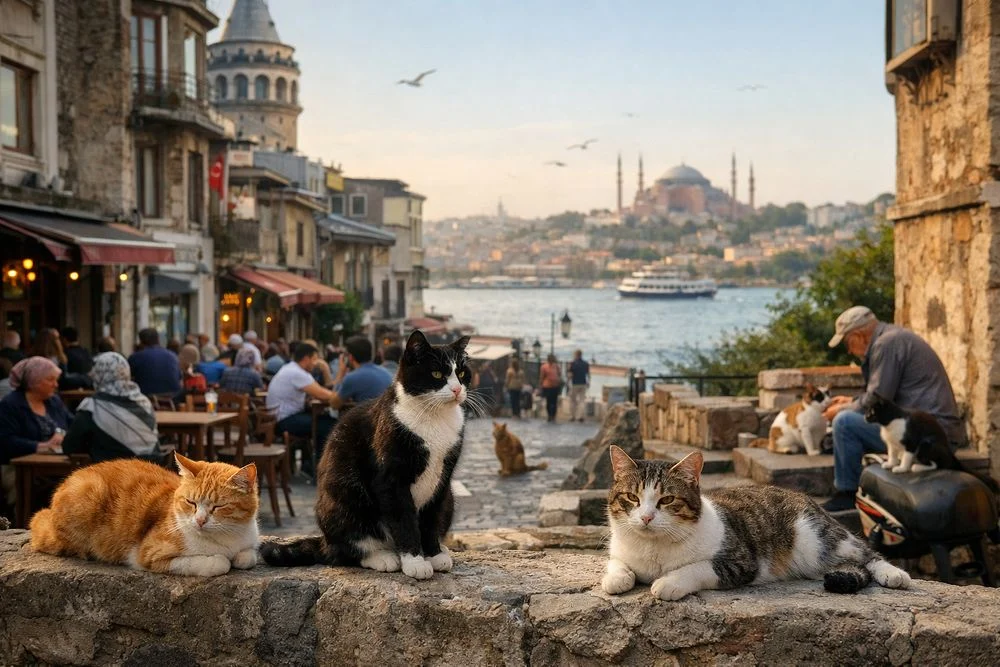
Visit Istanbul and you may notice something strange.
You see a cat.
Then another one.
Then three more sitting outside a café.
You walk down another street.
More cats.
You sit at a restaurant.
A cat is staring at you.
You visit a historic building.
There is a cat.
You take a ferry.
There may be a cat.
At some point, you stop asking, “Where did all these cats come from?”
and start asking,
“Am I actually visiting Istanbul, or have I accidentally entered a giant cat kingdom?”
Welcome to Istanbul.
A city where humans built the streets, palaces, mosques and cafés...
and the cats apparently decided to move in and supervise everything.
But why are there so many cats in Istanbul?
The answer involves history, religion, city life, and a very long-standing relationship between humans and cats.
And, of course, cats being extremely good at finding places where humans are willing to feed them.
Istanbul Really Is Full of Cats
Street cats are part of everyday life in Istanbul.
You'll find them sleeping on sidewalks, wandering through markets, sitting outside shops, lounging in parks and curling up on café chairs.
Some are completely comfortable around people.
Others behave like tiny celebrities who have agreed to acknowledge the public only on special occasions.
And locals often know the cats living in their neighborhood.
People may leave food and water outside their homes or businesses. Some communities also provide shelters for cats, especially during cold weather.
So these aren't simply random cats wandering around a huge city.
In many parts of Istanbul, they are almost part of the neighborhood.
A shop might have a regular cat.
A café might have a regular cat.
A street might have several.
And if you're lucky, one may decide that your lap is now public property.
It All Goes Back Centuries
Cats have been associated with Istanbul for a very long time.
One important reason is the city's history as a major port.
For centuries, Istanbul was a crossroads connecting Europe and Asia. Ships arrived carrying food, goods and people from different parts of the world.
And where there are ships...
there are often rats.
And where there are rats...
there are cats.
Cats were useful aboard ships because they could help control rodents that threatened food supplies and cargo.
As ships arrived and cats jumped—or were carried—into port areas, some stayed behind.
Why leave?
There was food.
There were buildings.
There were warm places to sleep.
And, importantly, there were humans who didn't seem to mind having cats around.
From a cat's perspective, Istanbul was basically a five-star relocation opportunity.
Free food. Warm buildings. Lots of hiding places. Minimal rent.
Obviously, the cats were going to stay.
Cats and Islam
Another important part of the story is the cultural and religious status of cats in Islamic societies.
Cats have traditionally been treated with affection and respect in many Muslim communities.
The Prophet Muhammad is widely associated in Islamic tradition with kindness toward cats, and stories about his relationship with cats have helped reinforce their positive cultural image.
However, some popular stories about cats and the Prophet are difficult to verify historically, so it's worth separating well-established Islamic teachings about kindness to animals from later legends and folklore.
What is clear is that cats have generally enjoyed a favorable reputation in Islamic culture.
They are considered clean animals in Islamic tradition, and there are historical accounts of cats living around mosques and other public spaces.
This helped create an environment in which cats were not simply tolerated as pests.
They could become part of everyday urban life.
And Istanbul took that relationship to another level.
The Ottoman Empire Had a Serious Cat Problem
And by “problem,” we mean a problem that many cat lovers would happily have.
During the Ottoman period, cats were common in Istanbul.
They lived around homes, markets, mosques, courtyards and other urban spaces.
Some people actively fed them.
There were also charitable traditions surrounding care for animals.
Historical records describe charitable foundations and individuals providing food for animals, including cats and birds.
In other words, Istanbul had something that modern cat owners understand very well:
Someone has to pay for the food.
The difference is that Istanbul developed traditions in which caring for street animals could be considered a charitable act.
So the cats had humans looking after them.
The humans had cats controlling the neighborhood.
Everyone seemed reasonably happy with the arrangement.
Why Didn't Istanbul Simply Get Rid of the Street Cats?
This is where Istanbul differs from many modern cities.
In some places, large populations of stray animals have historically been viewed mainly as a public-health or sanitation problem.
Istanbul developed a different cultural relationship with its street animals.
Cats became part of the city's identity.
They weren't simply animals living in Istanbul.
They became animals associated with Istanbul.
You could remove the cats from a street, but eventually another one would appear.
Because Istanbul provides exactly what an adaptable city cat needs:
- Food from residents and businesses
- Plenty of hiding places
- Warm spots
- Human contact
- Buildings and courtyards
- Parks and gardens
- A relatively cat-friendly urban culture
In other words, Istanbul accidentally created an enormous outdoor cat condominium.
The residents just happen to have whiskers.
Then Came the Mosques
Walk around Istanbul and you'll often find cats near mosques.
Some cats wander through courtyards.
Some sleep near entrances.
Some simply sit around looking important.
This isn't necessarily because every mosque has officially “adopted” a cat.
Rather, cats have historically lived around religious buildings and other sheltered public spaces, where people were often willing to feed them.
And cats seem particularly good at finding peaceful places.
A quiet courtyard?
Perfect.
Warm stone in the sunshine?
Excellent.
A sheltered corner where nobody bothers you?
Five stars.
A human who happens to be carrying food?
Even better.
Istanbul Cats Are Basically Local Celebrities
Here's something visitors quickly discover:
Istanbul's cats don't behave like animals who are afraid of people.
Many are surprisingly confident.
They walk into cafés.
They sit beside strangers.
They pose in shop windows.
They sleep on parked cars.
They occupy chairs.
They casually stroll across sidewalks as pedestrians wait.
And occasionally, they look at tourists with an expression that seems to say:
“Yes, you may take a photograph. But please remember who lives here.”
This confidence isn't completely surprising.
Cats that grow up around humans and regularly receive food or positive interactions can become comfortable with people.
Over generations, a city with lots of human-cat interaction naturally produces many cats that are very familiar with human environments.
And Istanbul has had a lot of practice.
The Cats Even Have Their Own Movie
If you want to understand Istanbul's relationship with cats, there's a wonderful place to start: the 2016 documentary Kedi.
The film follows several free-roaming cats living in Istanbul and explores their relationships with the people and neighborhoods around them.
Instead of treating the cats as background scenery, Kedi makes them the stars.
Which is probably the most accurate casting decision ever made.
The documentary shows different personalities and lifestyles among Istanbul's cats.
Some are hunters.
Some are affectionate.
Some are independent.
Some are neighborhood characters.
Basically, the film confirms what every cat owner already suspects:
Cats are individuals, and every single one believes it is the main character.
Not Every Istanbul Cat Is the Same
One of the most interesting things about Istanbul's street cats is their variety.
Some are friendly enough to approach strangers.
Others prefer to keep their distance.
Some are regular visitors to cafés.
Some spend most of their time outdoors.
Some have particular humans they trust.
Others appear to have no permanent allegiance whatsoever.
This is important because “Istanbul cat” isn't really a breed.
Most are domestic cats of mixed ancestry, and their appearances vary widely.
You might see a fluffy white cat.
A tabby.
A black cat.
A ginger cat.
A tuxedo cat.
A cat with one suspiciously dramatic expression.
And probably a cat who looks exactly like the cat you had when you were a child.
Except this one has apparently inherited the city.
Why Do People Feed Them?
Food is obviously a huge part of the relationship.
Residents, shopkeepers and animal lovers often provide food and water for street cats.
You may see bowls outside buildings or businesses.
Some neighborhoods also have people who regularly look after particular groups of cats.
This creates a kind of informal community care system.
And cats are very good at remembering where the food is.
Imagine walking through a neighborhood every day and knowing exactly which five houses have snacks.
That's not a stray cat.
That's a professional.
But There Is a Serious Side to the Story
It's easy to look at photographs of Istanbul's cats and think:
“This is paradise!”
And in many ways, Istanbul is unusually cat-friendly.
But life as a street cat isn't automatically easy.
Outdoor cats face traffic, disease, injuries, fights, parasites, harsh weather and limited access to veterinary care.
Population management can also be complicated when large numbers of free-roaming animals live in densely populated urban areas.
That is why community feeding alone isn't the entire solution.
Responsible care can also involve veterinary treatment, vaccination, sterilization and efforts to monitor animal populations.
So while Istanbul's relationship with cats is beautiful, it also comes with real challenges.
The city has spent generations figuring out how humans and free-roaming cats can share the same urban space.
Why Don't the Cats Run Away From Tourists?
Because many of them have learned something very important:
Tourists are excellent sources of attention.
Some Istanbul cats seem completely comfortable walking up to visitors.
And tourists absolutely love it.
One cat sits on a bench.
Someone takes a photo.
Another cat appears.
Another photo.
Five minutes later, the tourist has taken 73 pictures and hasn't photographed a single historical monument.
This is how cats quietly destroy sightseeing itineraries.
You came to see the Hagia Sophia.
You left with 200 photos of a ginger cat sleeping on a scooter.
Honestly?
Fair trade.
The Real Secret: Istanbul Has Learned to Live With Cats
So, why are there so many cats in Istanbul?
There isn't one single answer.
It's the result of several things coming together:
Centuries of urban history.
Cats arriving through trade and shipping.
Their usefulness in controlling rodents.
A cultural and religious tradition of treating cats positively.
Communities feeding and caring for street animals.
A city full of sheltered spaces and food sources.
And perhaps most importantly, generations of humans simply becoming accustomed to sharing their city with cats.
Over time, the cats stopped being temporary visitors.
They became part of the neighborhood.
Part of the scenery.
Part of the culture.
And, eventually, part of Istanbul's identity.
Istanbul May Be the World's Biggest Cat Café
There's something wonderfully funny about the whole situation.
Most cities have cats.
Istanbul has cat infrastructure.
There are cat beds.
Food bowls.
Shelters.
Neighborhood caretakers.
Cafés where cats wander around.
Tourists taking photographs.
Locals who know which cat belongs to which street.
And millions of people online who have watched videos of Istanbul cats and immediately thought:
“I need to go there.”
The cats have essentially created a tourism industry without doing any marketing.
No advertising campaign.
No social media manager.
No influencer contracts.
Just cats.
Lots and lots of cats.
So, Who Really Owns Istanbul?
Officially, Istanbul belongs to its millions of human residents.
But if you ask the cats?
The answer may be slightly different.
The humans built the city.
The cats moved in.
The humans provide food.
The cats provide entertainment.
The humans pay rent.
The cats occupy the best seats.
Sounds familiar, doesn't it?
Maybe Istanbul isn't a city with lots of cats after all.
Maybe it's a giant cat community where humans were generously allowed to build infrastructure.
And once you've walked through Istanbul and seen a cat sleeping peacefully outside a centuries-old building, sitting in a café, or casually watching the world go by from a windowsill, it's surprisingly easy to understand why the city has fallen in love with them.
Because in Istanbul, cats aren't just pets.
They aren't simply strays.
They're part of the city.
And judging by the way they walk around like they own the place...
they probably know it.