 HBWEB GAME PORTAL
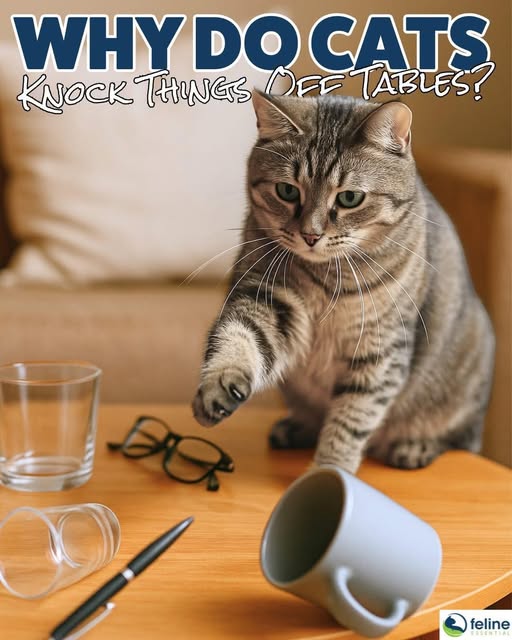
You buy a beautiful new mug. Your cat pushes it off the table.
You carefully arrange your skincare products. Your cat sends them flying like tiny bowling pins.
You put your phone down for exactly three seconds. Your furry roommate stares directly into your soul, extends one paw, and slowly nudges it toward the edge.
You say, “DON’T YOU DARE.”
Your cat makes eye contact.
Plop.
Congratulations! You have just witnessed another episode of Things My Human Owns That Must Be Destroyed.
But why do cats knock things off tables? Are they secretly little troublemakers? Do they hate your furniture? Or are they conducting a scientific experiment to determine how many objects can hit the floor before their human completely loses it?
The truth is a little more interesting. Cats knock things over for several reasons, including curiosity, playfulness, hunting instincts, and learned behavior. Sometimes, they simply want your attention.
And sometimes, they seem determined to remind you that you may own the table, but they own the entire household.
Let's investigate the tiny criminals.
1. Your Cat Is a Tiny Scientist Conducting Very Important Research
Have you ever watched your cat push an object toward the edge of a table?
It rarely looks accidental.
The paw reaches out. One gentle tap. A pause. Another tap. The object moves a little closer to the edge.
Your cat watches carefully.
Then comes the final push.
CRASH.
The experiment is complete.
Cats are naturally curious animals. They explore their environment using their eyes, noses, paws, and mouths. Touching an unfamiliar object helps them discover what it is and how it behaves.
Is that pen solid? Does the bottle roll? What happens if the coaster moves? Does the mysterious little object make a noise when it lands on the floor?
Your cat has questions, and apparently, your favorite coffee mug is the ideal research subject.
Moving objects can also provide immediate feedback. A lightweight pen might roll away, while a bottle might wobble. A small tap can turn an ordinary object into an interesting source of movement and sound.
For a curious cat, that's entertainment.
For you, it's an unexpected home renovation bill.
Your cat doesn't necessarily want to destroy your belongings. It may simply be exploring them in the most financially irresponsible way possible.
2. Congratulations! Your Cat Has Discovered Gravity
Humans learn about gravity in school.
Cats prefer hands-on experiments.
A pen sits on the table. Your cat touches it. The pen falls.
Interesting.
Your cat tries again with a bottle cap.
It falls, too.
Now your cat is staring at the floor as if it has uncovered one of the universe's greatest mysteries.
Of course, we can't know exactly what a cat is thinking when it pushes an object off a table. It's tempting to imagine a tiny scientist developing a theory of gravity, but the behavior may be much simpler: the cat touched something, it moved, and the result was interesting.
Movement can be rewarding in itself. A falling object creates a sudden visual change and sometimes an exciting noise. If the object rolls or bounces, it may become even more appealing.
This is especially true for cats that enjoy batting toys around.
The problem is that your cat doesn't necessarily distinguish between a toy mouse and the expensive wireless earbuds you just bought.
To your cat, both are small objects that fit under one paw.
To you, one costs considerably more to replace.
Perhaps it's time to introduce your cat to a revolutionary concept: not everything that moves is a toy.
Good luck with that.
3. Your Cat's Hunting Instincts May Be Kicking In
Even though your cat receives regular meals, its natural hunting instincts haven't magically disappeared.
Domestic cats retain many behaviors associated with their wild ancestors, including watching, stalking, chasing, pawing, and pouncing on moving targets.
A small object on a table can trigger some of those behaviors.
A dangling string, a rolling bottle cap, or a pen that moves after a gentle tap may look interesting because it resembles the kind of movement that attracts a cat's attention.
The pawing motion itself can be part of the fun. Your cat doesn't need to be hungry to enjoy an activity that engages its natural instincts.
This is why an ordinary household object can suddenly become more exciting than the perfectly good toy you bought specifically for it.
You purchase a feather wand.
Your cat ignores it.
You place a receipt on the table.
Your cat enters professional hunting mode.
You could spend a fortune on toys, but apparently, the packaging and paperwork department remains undefeated.
If your cat frequently bats objects around, try offering safe toys that move, roll, or can be chased. Wand toys, soft balls, and food puzzles can provide more appropriate ways to explore and play.
Just remember to put string toys away after supervised play, since swallowed string can be dangerous.
Your cat needs an outlet for its hunting instincts. Your favorite glass doesn't need to become part of the food chain.
4. The Real Reason Might Be You
This one might hurt a little.
Imagine the following scene.
You're working on your laptop. Your cat approaches and sits beside you.
You continue typing.
Your cat places one paw on your notebook.
You keep typing.
Your cat slowly pushes a pen toward the edge of the table.
You glance up.
Your cat has your attention.
Mission accomplished.
Cats can learn through experience. If knocking something over reliably makes you look at them, speak to them, stand up, or rush across the room, the behavior may become more rewarding.
Even negative attention can be attention.
From your perspective, you're saying, “STOP THAT!”
From your cat's perspective, you've suddenly abandoned your boring computer activity to participate in a thrilling new game.
The rules are simple:
- The cat touches an object.
- The human makes an interesting noise.
- The human moves around.
- The cat has successfully activated the human.
It's basically a remote control, except the buttons are your belongings and the batteries are your remaining patience.
This doesn't mean your cat is deliberately plotting to annoy you. It may simply have learned that a particular action produces a predictable response.
If your cat tends to knock things over when you're busy, try giving it attention and playtime before you settle down to work. Reward calm behavior when you can, and avoid turning every little push into an exciting chase.
You can also calmly move tempting objects out of reach instead of making a dramatic scene each time.
The less entertaining the human reaction, the less rewarding the performance may become.
At least, that's the theory. Your cat may have its own interpretation.
5. Your Cat Might Be Bored Out of Its Tiny Mind
Let's be honest: a cat's indoor life can sometimes become predictable.
Wake up. Eat. Groom. Sleep. Wake up. Eat again. Stare out the window. Judge the neighbor's garden.
Repeat until further notice.
Indoor cats can have wonderful lives, but they still need opportunities to play, explore, climb, investigate, and use their brains.
When an environment offers too little stimulation, a curious cat may invent its own entertainment.
Unfortunately, its creative ideas might include knocking your keys off the counter, throwing a hair tie under the fridge, or repeatedly pushing a bottle cap into a place you'll never find it again.
Your cat doesn't necessarily think, “I'm bored, so I'll destroy the kitchen.”
It may simply notice an object, become interested in it, and discover that interacting with it is fun.
The solution isn't to buy your cat every toy in the pet store. It's to provide a variety of activities and rotate them so they remain interesting.
Try:
- Interactive play: Use a wand toy to encourage chasing and pouncing.
- Puzzle feeders: Let your cat work for some of its food instead of eating every meal from an ordinary bowl.
- Climbing spaces: Provide cat trees, shelves, or other safe elevated areas.
- Window watching: Give your cat a comfortable place to observe outdoor activity.
- Toy rotation: Put some toys away and bring them back later so they feel new again.
A few short play sessions throughout the day may help, especially if you notice the object-pushing happens when your cat has lots of unused energy.
You may not be able to eliminate every fallen pen, but at least your cat will have more interesting things to do than auditioning your belongings for a free-fall competition.
6. Why Does Your Cat Look Directly at You Before Pushing Something Off?
Ah, the eye contact.
The slow paw movement.
The tiny pause.
The unmistakable expression that seems to say, “Are you watching this?”
It's almost impossible not to interpret the behavior as deliberate mischief.
But let's be careful before accusing your cat of developing a personal vendetta against your favorite belongings.
Cats can learn which actions get a response from their humans. They can also be sensitive to movement, attention, and what happens around them.
If you've reacted strongly to an object being pushed off the table in the past, your cat may have learned that this behavior is especially effective at getting you to engage.
It might also simply be looking at you because you're nearby while it investigates the object.
Eye contact alone doesn't prove that your cat understands the consequences in the same way you do—or that it's pushing the object over specifically to upset you.
Still, the timing is suspicious enough to deserve its own detective series.
CSI: Cat Scene Investigation.
The suspect has four paws, no remorse, and a long history of knocking things off shelves.
The evidence? A shattered plant pot.
The motive? Unknown.
The judge? Also the cat.
7. Why Does Your Cat Knock Things Over Only When You're Watching?
Sometimes, it seems as though your cat saves its best performances for an audience.
You walk into the kitchen, and a bottle cap immediately goes flying.
You sit down to read, and your cat begins rearranging your desk.
You get comfortable on the sofa, and your cat starts pushing objects off the side table as if it has a personal quota to meet.
There are a few possible explanations.
First, your presence may make the situation more rewarding. If knocking things over gets a reaction from you, your cat may repeat the behavior when you're around.
Second, cats are often active and curious at particular times of the day. If those moments happen to coincide with your working hours or relaxation time, it can look like a personal attack.
Third, you may simply notice the behavior more when you're present. If your cat bats a harmless object around while you're in another room, you might never know about it.
The key is to look for patterns.
Does your cat do this when it wants to play? When you're working? Before meals? When you haven't interacted with it for a while?
Understanding the situation can help you work out what your cat might be getting from the behavior.
Then you can offer a more appropriate alternative.
For example, if it happens while you're working, give your cat a short play session beforehand and provide a nearby comfortable resting place or puzzle toy.
You can also keep fragile items away from the edge of the desk.
Because, as it turns out, prevention is considerably cheaper than replacing a phone screen.
8. How to Stop Your Cat From Knocking Everything Off the Table
You probably won't convince your cat to sign a legally binding agreement promising never to touch another object.
But you can make the behavior less rewarding and give your cat better options.
Make Tempting Objects Less Accessible
Start with the obvious: move fragile, valuable, or dangerous objects away from table edges.
Store small items such as hair ties, rubber bands, pins, and other swallowable objects safely. Keep medicines, cleaning products, and breakable containers out of reach.
If your cat has a favorite launchpad—such as a kitchen counter or desk—keep that area as clear as practical.
This isn't surrender.
It's strategic furniture management.
Give Your Cat More Appropriate Things to Bat Around
Provide safe balls, soft toys, and other cat-friendly objects that can be pushed, chased, or carried.
Try different textures and movements to discover what your cat enjoys. Some cats prefer lightweight balls, while others enjoy toys that move unpredictably.
Rotate the options rather than leaving every toy out all the time.
And yes, your cat may still prefer the bottle cap.
Cats are not famous for respecting your purchasing decisions.