 HBWEB GAME PORTAL
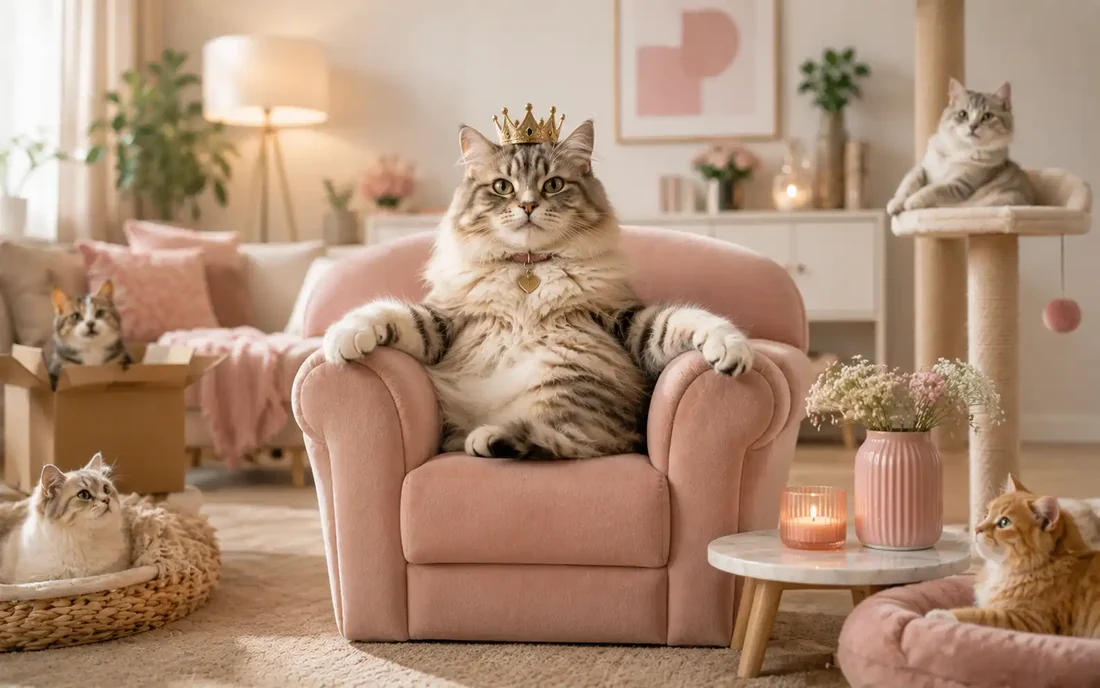
You pay the mortgage. You pay the bills. You buy the food, clean the floors, and occasionally spend an unreasonable amount of money on a tiny bed that your cat refuses to use.
Meanwhile, your cat sleeps in the middle of your bed, occupies your favourite chair, and stares at you when dinner is three minutes late.
So, let’s review the evidence.
Who gets the best seat in the house? The cat.
Who decides when cuddles begin and end? The cat.
Who can wake you up at an ungodly hour and still look offended when you complain? You guessed it.
At this point, calling yourself a cat owner feels a little ambitious. You may simply be an unpaid employee living in your cat’s property.
But here’s the interesting part: while your cat probably hasn’t drawn up a legal document claiming ownership of your living room, many of its behaviours have perfectly reasonable explanations. Cats seek comfortable resting places, explore their surroundings, use scent to feel secure, and learn which actions get a response from their humans.
Unfortunately, these perfectly normal feline behaviours also happen to make cats look like tiny landlords.
Let’s examine the evidence.
1. Exhibit A: Your Cat Has Claimed Your Bed
You have an entire bed. Your cat has approximately 15 centimetres of space beside your pillow.
Yet somehow, you’re the one sleeping diagonally on the very edge.
Your cat, meanwhile, is stretched out like a retired millionaire who has just returned from an exhausting holiday.
How did this happen?
Cats often choose resting places that feel warm, comfortable, and safe. They may also prefer spots that smell familiar, including places where their favourite humans spend a lot of time.
Your bed checks practically every box. It’s soft, warm, and full of your scent. It may also be elevated enough to give your cat a good view of its surroundings.
In other words, your cat hasn't necessarily stolen your bed out of spite. It has simply discovered excellent real estate.
And because cats don't understand the concept of personal space in quite the same way humans do, your side of the mattress may look like an entirely reasonable extension of its sleeping territory.
The evidence: You bought a king-size bed. Your cat believes you bought a king-size cat bed with complimentary human heating.
2. Exhibit B: Every Chair Becomes Yours Only When You Stand Up

You sit down to work. Your cat is nowhere to be seen.
You stand up for approximately four seconds to get a glass of water.
When you return, your chair is occupied.
Not just occupied. Occupied with confidence.
Your cat has curled into the exact centre of the seat, arranged its paws beautifully, and begun washing itself. It looks as though it has been waiting for this promotion its entire life.
Why does this happen?
The chair may still be warm from your body. It also carries your scent, and cats can find familiar smells reassuring. Some cats are particularly interested in locations where their humans have been sitting or working.
There may also be a simple matter of timing: cats notice interesting changes in their environment. When you get up, an appealing spot suddenly becomes available.
And if you repeatedly give your cat attention when it occupies your chair, the behaviour may become even more rewarding.
Does your cat understand that you need the chair to finish your work?
Possibly not in the way you'd hope.
Does it understand that sitting there makes you talk to it, look at it, or attempt a negotiation?
It may have learned that quite successfully.
The evidence: Your cat has never attended a meeting, completed a spreadsheet, or paid a utility bill. Yet somehow, it has become the most powerful person in the office.
3. Exhibit C: Your Laptop Is Now a Cat Bed
You have a deadline.
Your inbox is overflowing. Your coffee is getting cold. You finally sit down to concentrate.
Then a furry body appears and settles directly on your keyboard.
Not beside the keyboard.
Not on the comfortable cushion you bought specifically for this purpose.
On the keyboard.
Your cat may even look directly at you while pressing a mysterious combination of keys that somehow opens 47 windows.
Why the laptop?
Electronic devices can provide warmth, and cats often seek comfortable resting places. Your laptop is also an object that receives a great deal of your attention. Some cats seem particularly interested in whatever their humans are focused on.
If sitting on the keyboard consistently makes you speak, move your hands, or interact with them, that response may help reinforce the behaviour.
Your cat doesn't need to understand your job description. It only needs to discover that the rectangular object gets more attention than it does.
And frankly, that is unacceptable.
From the cat's perspective, however, the situation is obvious: you have been staring at a glowing rectangle for hours instead of admiring the living, breathing masterpiece sitting beside you.
Perhaps you should reconsider your priorities.
The evidence: Your cat has no professional qualifications, but it has successfully interrupted more meetings than your entire department.
4. Exhibit D: Your Sofa Is Being Renovated Without Your Permission
You bought a beautiful sofa.
You chose the colour carefully. You compared prices. You imagined relaxing on it after a long day.
Your cat saw the sofa and immediately began scratching it.
Not a little scratch.
A full renovation project.
The armrest now has a new texture, the fabric is developing an abstract pattern, and your cat appears deeply satisfied with its interior-design choices.
Is your cat deliberately destroying your furniture?
Usually, no.
Scratching is a normal feline behaviour. It helps cats maintain their claws, stretch their bodies, and leave visual and scent signals in their environment. Scent glands in their paws release chemical signals as they scratch.
Cats may also prefer prominent objects in areas where they spend time, making the sofa an appealing target.
Unfortunately, your cat does not understand that the sofa cost more than several months of its favourite treats.
The solution is not to assume your cat is being naughty. Instead, provide suitable scratching posts or pads that are stable, appealing, and placed near the furniture your cat likes to scratch. Different cats prefer different materials and orientations, so you may need to experiment.
You can also reward your cat for using the appropriate scratching surface.
Will your cat appreciate your thoughtful investment?
Perhaps.
Will it continue to look at the sofa with suspicious interest?
Almost certainly.
The evidence: You hired no interior designer, yet your cat has begun a complete redesign. Payment is accepted in treats.
5. Exhibit E: Your Cat Conducts Security Checks at 3 A.M.
It's the middle of the night.
The house is quiet. Everyone is asleep.
Suddenly, you hear footsteps running down the hallway. Something bumps into a door. A mysterious object falls off a shelf.
Your cat races past your bedroom like it has just remembered an appointment with destiny.
Then, silence.
Five minutes later, the entire performance begins again.
Welcome to the overnight security department.
Cats naturally alternate between periods of rest and activity, and many become especially active around dawn and dusk. Their hunting instincts can also inspire stalking, chasing, pouncing, and bursts of energetic play.
Indoor cats may become more active at night if they have not had enough opportunities to play and explore during the day.
So while your cat may appear to be conducting a dramatic patrol of the property, it could simply have energy to burn.
Regular interactive play, especially before bedtime, may help provide an appropriate outlet for these behaviours. Food puzzles and opportunities to climb, explore, and investigate can also make the indoor environment more engaging.
Of course, none of this explains why the security patrol must involve a plastic bottle being kicked down the stairs.
Some mysteries remain unsolved.
The evidence: You sleep eight hours. Your cat sleeps whenever it feels like it, then schedules a high-speed inspection of the hallway at an hour normally reserved for emergency plumbing.
6. Exhibit F: Your Cat Supervises Everything You Do
You cook. Your cat watches.
You clean. Your cat watches.
You fold laundry. Your cat sits directly on the pile of clean clothes.
You try to have a private conversation. Your cat appears in the background, staring at you with the intensity of a detective who suspects you are hiding something.
It's difficult to do anything without feeling observed.
Cats are naturally curious. They investigate changes in their environment and often pay attention to the activities of familiar people. Some also enjoy being close to their humans, even when they don't particularly want to be touched.
This is an important distinction: a cat can want company without wanting constant cuddles.
Your cat might follow you from room to room, then refuse to sit on your lap. It might settle nearby, watching quietly, and move away if you reach for it.
In feline terms, this can be a perfectly reasonable arrangement.
You are allowed to be present.
You are not necessarily allowed to initiate a meeting.
The evidence: You thought you were the main character of your own life. Your cat appears to have hired you as a personal assistant and is monitoring your performance.
7. Exhibit G: Your Cat Has More Furniture Than You Do
Let's take a tour of your home.
There's a cat tree beside the window. A soft bed sits in the bedroom. A tunnel occupies the hallway. A cardboard box has been placed in the living room because your cat suddenly decided it was the most interesting object in the world.
And yet, your cat sleeps inside an empty shopping bag.
Why?
Cats often benefit from having a variety of resting places, hiding spots, elevated spaces, and opportunities to observe their surroundings. Different locations may appeal at different times depending on temperature, comfort, noise, and whether the cat wants to feel sheltered.
A box, for example, can offer a cosy hiding place with walls that help a cat feel protected.
Your expensive cat bed may be perfectly comfortable. Unfortunately, comfort is only one factor in a cat's decision-making process.
Familiar smells, location, privacy, and personal preference matter too.
You cannot simply purchase your way into feline approval.
You can, however, keep suitable options available and let your cat choose among them.
This is why experienced cat owners eventually stop asking, "Why won't you use the thing I bought you?"
They simply leave the box on the floor and wait for the cat to discover it six weeks later.
The evidence: You furnished the house according to a budget. Your cat furnished it according to mysterious architectural principles known only to cats.
8. Exhibit H: Your Cat Has Successfully Trained You
At first, you had rules.
No feeding before breakfast. No treats just because the cat meowed. No getting out of bed to open a door that the cat would probably want to close again five minutes later.
Then the meowing began.
You gave your cat a snack.
It meowed again.
You gave it another snack.
Soon, you were responding to a particular sound with the speed of an emergency-services operator.
Congratulations. Your cat has discovered how learning works.
Cats can learn associations between their behaviour and the results that follow. If meowing consistently makes food appear, the cat may repeat the behaviour. If sitting on your keyboard reliably gets your attention, that behaviour may also become more frequent.
This doesn't mean your cat is plotting world domination in the human sense. It means that behaviour that produces a useful result can be repeated.
Humans do the same thing. We press the elevator button more than once even though we know it won't make the lift arrive faster.
Your cat has simply mastered a different set of buttons.
The good news is that you can also encourage behaviours you prefer. Reward your cat for using its scratching post, settling in an appropriate place, or playing with its toys. Try to avoid accidentally rewarding unwanted behaviour every time it happens.
Consistency helps.
Unfortunately, consistency is difficult when the tiny creature in question is making a noise that sounds remarkably like a broken kettle.
The evidence: You thought you were training a cat. Your cat has been running a long-term experiment on human behaviour, and the results are extremely promising.
9. Exhibit I: Your Cat Owns the Best View in the House

The windowsill is occupied.
The top of the bookshelf is occupied.
The highest shelf that you thought was completely impractical is also occupied.
Your cat appears determined to inspect the world from every available elevation.
This behaviour makes sense. Elevated resting places allow cats to observe their surroundings and may help them feel secure. Height can also offer a comfortable retreat from household activity.
A window provides something even better: moving leaves, passing birds, distant people, and an endless supply of outdoor entertainment.
To your cat, the world outside is a live television channel that never needs a subscription.
You may have paid for a large screen and a streaming service, but your cat prefers the window.
You can support this natural interest by providing safe, stable climbing and resting options. Make sure windows are secure and that elevated furniture cannot tip over.
If your cat enjoys watching birds, a comfortable window perch can provide mental stimulation without requiring it to roam outdoors.
The evidence: You call it a windowsill. Your cat calls it a private observation deck with premium wildlife programming.
10. Final Exhibit: The Entire House Smells Like Your Cat
Your cat rubs its cheeks against the corner of the sofa.
It circles the chair legs. It scratches a post near the doorway. It strolls past a table and brushes its face against the edge.
It may even greet you by rubbing against your legs.
Congratulations. You have been included in the household scent network.
Cats use scent as an important form of communication. They have scent glands around their cheeks, head, and other parts of the body, and they can leave chemical signals when rubbing against objects. Scratching also provides visual marks and deposits scent from glands in the paws.
These behaviours can help cats become familiar with their surroundings and communicate information to other cats.
So when your cat rubs against your furniture, it isn't necessarily stamping an imaginary deed of ownership.
It may simply be interacting with its environment in a normal feline way.
Still, the result is rather funny.
The house has your furniture, your decorations, your photographs, and your carefully chosen colour scheme.
But it also has a cat who has been rubbing its face on everything as if conducting a comprehensive property inspection.
The evidence: You decorated the house. Your cat has added its signature to the entire collection.
So, Does Your Cat Really Think It Owns the House?
Probably not in the same way a human understands property ownership.
Cats don't need to imagine themselves as landlords to behave in ways that make them look like landlords. They seek comfort, explore their surroundings, communicate through scent, and learn which behaviours produce results.
Their needs and preferences can sometimes clash spectacularly with human expectations.
You want an uninterrupted workday. Your cat wants to sit on the keyboard.
You want a spotless sofa. Your cat needs somewhere appropriate to scratch.
You want eight hours of sleep. Your cat has scheduled a midnight sprint.
Neither side is necessarily being unreasonable. You're simply sharing a home with an animal whose instincts, routines, and priorities differ from yours.
Providing suitable scratching surfaces, comfortable resting places, opportunities for play, and a predictable routine can help make that arrangement work for both of you.
And perhaps the most important lesson is this: you don't have to surrender every chair, every pillow, and every square inch of your living space.
You can set boundaries while still respecting your cat's needs.
Just don't expect your cat to read the house rules.
It will probably sit on them.
The Verdict
After reviewing the evidence, the court finds the cat guilty of:
- Unauthorised occupation of the bed.
- Repeated theft of office chairs.
- Unscheduled overnight security inspections.
- Renovation of upholstered furniture without permission.
- Excessive supervision of household activities.
- Persistent demands for snacks and attention.
The sentence?
A comfortable home, appropriate scratching posts, daily opportunities to play, nutritious meals, and plenty of affection on the cat's terms.
As for the human?
You may continue paying the bills.
The cat has declined to comment.